Process role
Submerged ceramic membrane solid-liquid separation
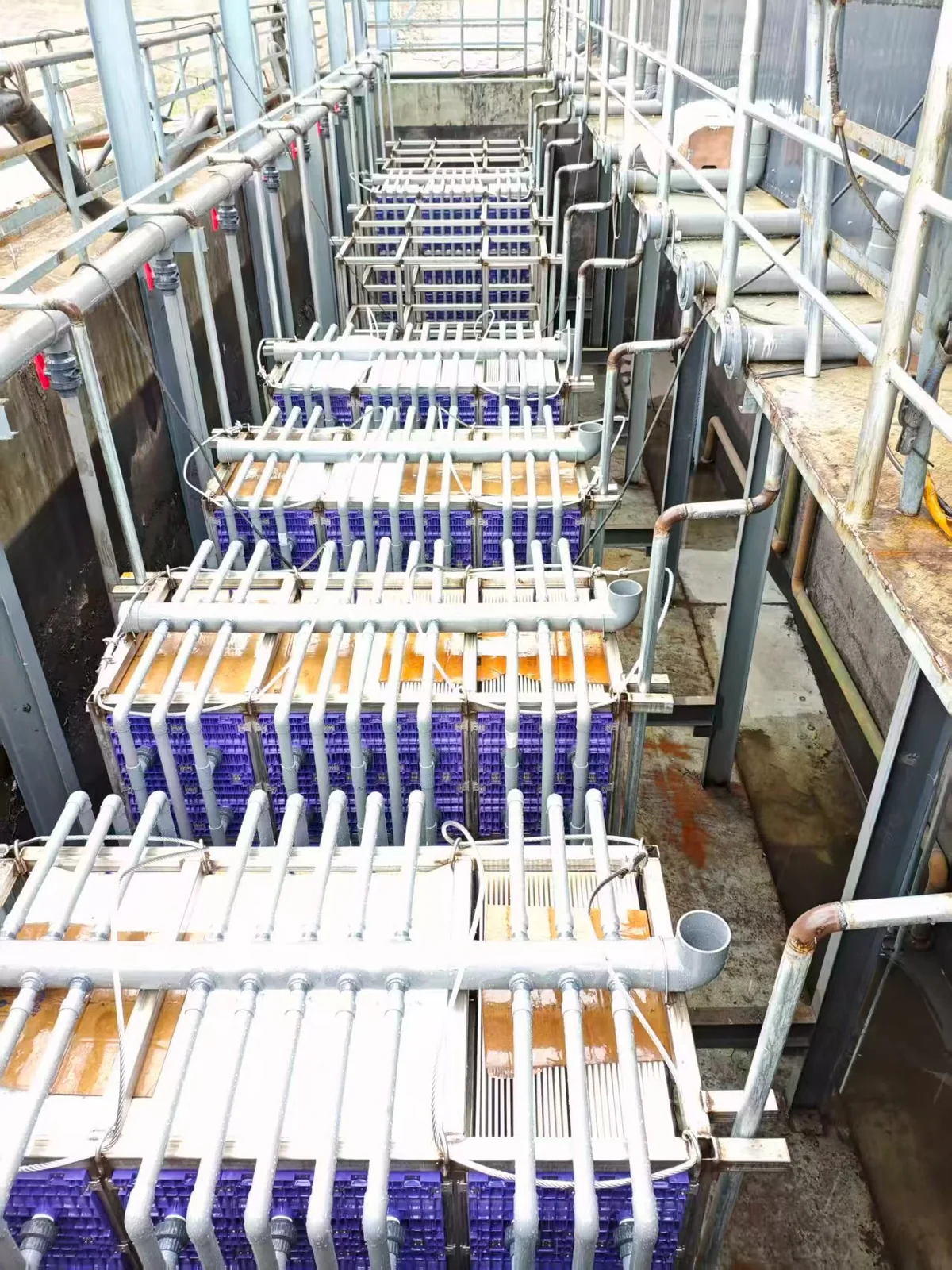
The installation uses rigid ceramic flat sheet elements assembled into submerged modules. The modules operate in an open tank, while a permeate pump draws treated water through the membrane. Suspended solids and fine particulate matter remain on the feed side and must be removed through the system’s solids-management strategy.
Mine waterCoarse screening / equalization as requiredSubmerged ceramic flat sheet membranePermeate tankReuse, discharge or downstream polishing
The ceramic membrane provides a physical barrier for suspended and colloidal material. It does not remove dissolved salts, hardness or every dissolved contaminant. If reverse osmosis is planned, the membrane permeate must still be checked against the RO supplier’s feed-water limits.
Why this configuration matched the application
- Rigid ceramic plates for a particulate and potentially abrasive environment
- Submerged, low-pressure filtration without a high-pressure cross-flow loop
- Open-tank modules that can be isolated, lifted and inspected
- Air scouring to reduce solids accumulation on membrane surfaces
- Physical and chemical cleaning options within verified product limits
- Modular expansion and maintenance planning around the required flow
What the recorded result means
Under the referenced site conditions, the application recorded permeate turbidity below 0.1 NTU. This indicates effective particulate and colloidal control at that site. It should not be interpreted as a guaranteed value for untreated mine water of every composition.
For a new project, the design team should confirm representative and worst-case water analyses, particle loading, membrane flux, transmembrane pressure trend, air demand, cleaning frequency, solids discharge and downstream water-quality requirements.
Engineering lessons for similar mine-water projects
- Start with solids mass, not turbidity alone. Flow and suspended-solids concentration determine the daily solids load that must leave the system.
- Protect the original drainage function. A membrane installation must not compromise mine-water storage, emergency drainage or safe maintenance access.
- Design residuals handling. Concentrated solids, tank drainage and cleaning waste need a defined destination.
- Verify the downstream interface. Reuse or RO feed objectives determine whether softening, iron and manganese control, cartridge filtration or other polishing is needed.
- Pilot difficult water. Variable or abrasive mine water may require a representative pilot to confirm sustainable flux and cleaning recovery.